

 E-Trésorerie
A next-generation tool to manage your cash flow. Manage your cash with total simplicity and gain visibility into your liquidity.
Request a demo →Manage your cash with total simplicity
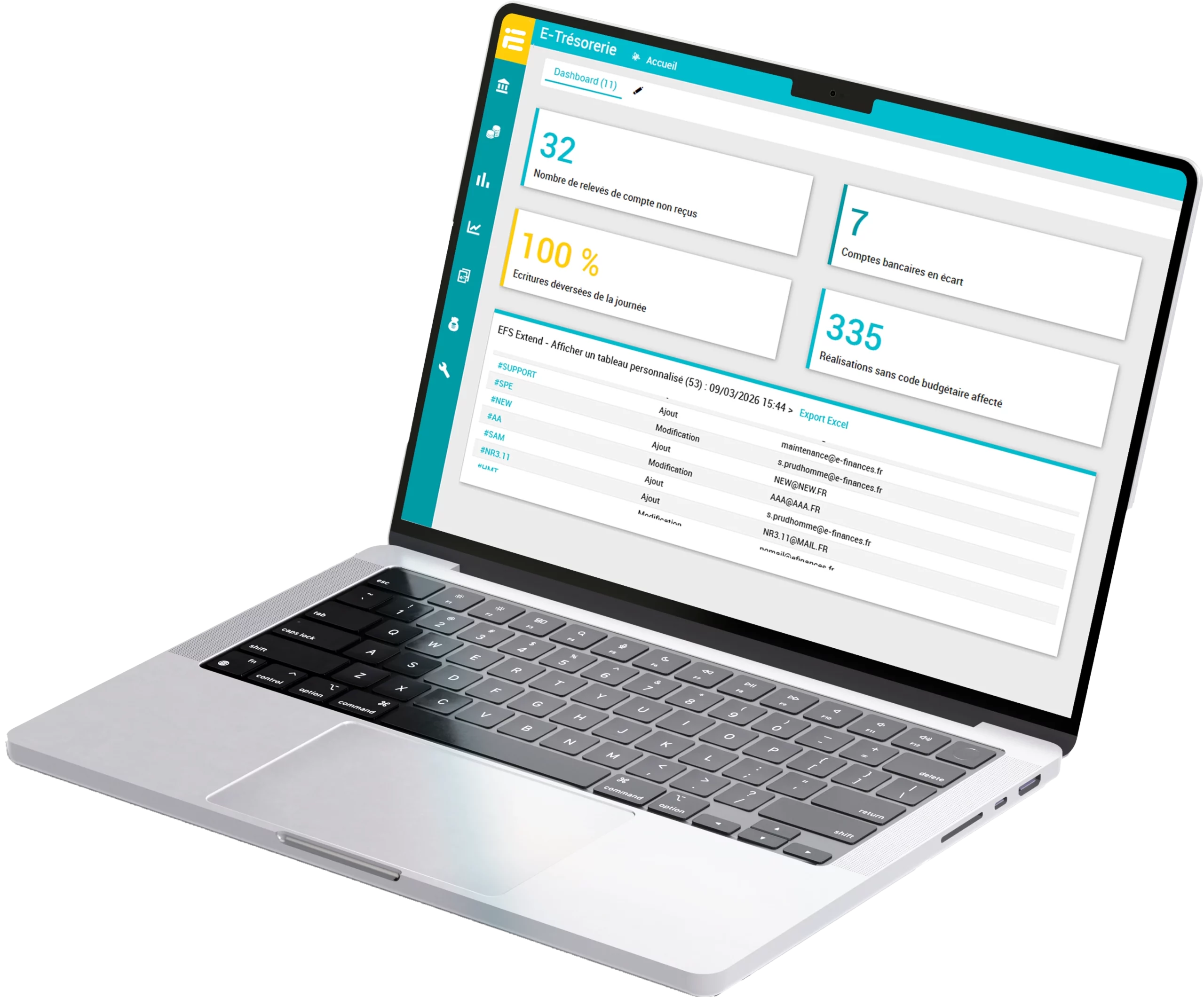
E-Trésorerie
Discover all the features that simplify your daily routine.
Your account statements and forecasts are automatically integrated into your tool.
Short, medium, and long term — anticipate potential cash flow gaps to optimize your forecasting.
By managing your financial resources through decision-making balances, investments, and financing.
Through analysis dashboards, customizable reports, and reporting.
By negotiating with your banking partners using tangible data: interest scales, transaction fees, quotas, and banking statistics.
Our tool draws on your past budgets and the factors influencing your treasury — currencies, market conditions, and geopolitics — to provide you with predictions.
Your options
Manage your current accounts instantly and track all your transactions without double entry.
Keep close track of your treasury budget.
Automatically generates the accounting entries linked to your treasury.
Our tool draws on your past budgets and the factors influencing your treasury — currencies, market conditions, and geopolitics — to provide you with predictions.
A modern solution
Client review
"E-Finances' strength lies in its industry expertise, its customer-first approach, and its near-immediate availability. Their products keep evolving to meet our needs."
Our advice
While an entrepreneur is generally expected to be a visionary, a salesperson, a mentor, an outstanding manager, or a true market expert, it's easy to forget that they also need to be able to improve their treasury management. Managing, forecasting, and anticipating a company's finances calls for genuine expertise in budget analysis and liquidity management.
In simple terms, a company's cash flow is the money it has available to run its day-to-day operations. It also has to cover expenses, both general ones (salaries, rent, purchasing or leasing equipment, for example) and, above all, very specific ones. These are notably linked to existing relationships with third parties — whether advisors, suppliers of products or services, or partners — with whom it carries out business transactions involving financial operations subject to regulated payment terms.
Ideally, a company should be able to rely on a reserve of liquidity when it assesses its finances once revenues are recorded and expenses factored into the balance sheet. Seeking balance is generally not an end in itself for an ambitious company, which will systematically look to generate surplus cash and consider the best ways to put available funds to use. Conversely, the balance sheet may show a cash shortfall, in which case the company will also need to ask itself the right questions to get through a temporary liquidity crisis and rebalance its budget.
So while a company can manage its budgets sensibly to avoid surprises and setbacks, it must above all place treasury management at the heart of its growth strategy. It needs to be able to build cash inflows and outflows into its short, medium, and long-term financing plan to ensure its various departments run smoothly and to secure its future.
As the entrepreneur's goal is to grow the business, smart management of its liquidity will let them free up part of the budget to reinvest the money generated by operations — increasing revenue streams by adding new products and/or services to the portfolio.
Well supported by a treasury management specialist, they can benefit from expert advice, someone able to flag opportunities created by available liquidity at any given moment — as well as the risks that come up when cash runs short and certain debts can't be settled on time.
A liquidity crisis is a difficult situation: an inability to meet debts owed to creditors, which can have disastrous consequences for the company's image externally, and can also undermine the trust of its own employees internally.
To avoid getting into this kind of situation, it's essential that the treasury team, equipped with the right monitoring and analysis tools, has a real-time view of the company's financial position. They also need to be able to anticipate short-term deficit scenarios and propose ways to resolve them as quickly as possible.
400 companies already trust us. Discover E-Trésorerie with an E-Finances expert.